Why Is the Idea Being Discussed Now?
Housing affordability continues to be Could the U.S. Adopt Canada’s Portable Mortgage System?
What Homebuyers and Homeowners Need to Know
For the past several years, millions of American homeowners have found themselves “locked in” to their current homes. Why? Because they have mortgage interest rates between 2% and 4% and don’t want to give them up.
This has contributed to one of today’s biggest housing challenges: fewer homes for sale and reduced affordability for buyers.
As policymakers explore ways to improve housing affordability and increase inventory, one idea gaining attention is the portable mortgage—a financing option that has been available in Canada for years.
So, what is a portable mortgage, and could it eventually become a reality in the United States?
What Is a Portable Mortgage?
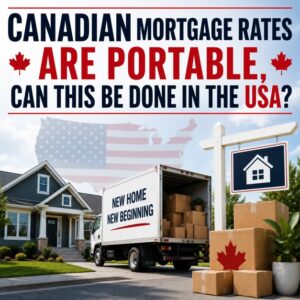
Unlike an assumable mortgage, which transfers a loan to a new buyer, a portable mortgage stays with the homeowner.
If you decide to move, you may be able to transfer your existing mortgage—including its low interest rate—to your next home.
In other words, instead of paying off your mortgage when you sell your house, you “carry” it with you to your new property.
Here’s an Example
Imagine you purchased a home in 2022 with:
- Mortgage Balance: $350,000
- Interest Rate: 2.75%
A few years later, your family has grown, and you’re ready to purchase a larger home.
Rather than replacing your 2.75% mortgage with a new loan at today’s higher interest rates, your lender allows you to transfer your existing mortgage to the new property.
If the new home costs more, you simply borrow the additional amount needed—often at current market rates. Some Canadian lenders combine the old and new financing into a blended interest rate, while others keep them as separate loan segments.
The result? You keep much of the benefit of your original low-rate mortgage while purchasing your next home.
Do Canadian Homeowners Automatically Qualify?
No.
One of the biggest misconceptions about portable mortgages is that homeowners can simply move their loan without any review.
In reality, borrowers must typically requalify with their lender.
The lender will usually evaluate:
- Income and employment
- Credit history and credit score
- Current debt obligations
- Loan-to-value (LTV)
- Debt-to-income ratios
- The value and condition of the new property
In other words, the lender still wants to ensure the borrower can comfortably afford the new home.
Why Doesn’t the U.S. Offer Portable Mortgages?
The answer lies in how mortgages are financed.
In Canada, many mortgages have shorter fixed-rate terms—often three to five years—and lenders generally retain greater control over the loans.
In the United States, however, most homeowners choose 30-year fixed-rate mortgages. Many of these loans are sold into the secondary mortgage market and packaged into mortgage-backed securities.
Because investors purchase those securities based on the mortgage being tied to a specific property, allowing a borrower to move that loan to another home would require significant changes to underwriting guidelines, servicing practices, and investor agreements.
Simply put, it’s much more complicated than it sounds.
Why Is the Idea Being one of the nation’s biggest concerns.
Millions of homeowners are delaying moves because they don’t want to give up their historically low mortgage rates. This “lock-in effect” has reduced the number of homes available for sale, making it even harder for buyers to find a home.
Some housing experts believe that allowing mortgage portability—or expanding assumable mortgages—could encourage more homeowners to sell while preserving the value of their existing financing.
More homes on the market could help improve inventory and create additional opportunities for buyers.
Could Portable Mortgages Come to America?
It’s possible—but nothing has been approved.
The Federal Housing Finance Agency (FHFA) has indicated it is evaluating ideas that could make conventional mortgages more flexible, including expanded assumability and, potentially, mortgage portability.
Any changes would require careful consideration of lender risk, investor protections, and underwriting standards before becoming reality.
What This Means for Homebuyers and Homeowners
While portable mortgages remain a concept under discussion, they highlight an important shift in how policymakers are thinking about housing affordability.
If adopted, portable mortgages could:
- Encourage more homeowners to move without sacrificing their low interest rates.
- Increase the number of homes available for sale.
- Improve affordability for move-up buyers.
- Create new financing options for future homeowners.
My Take
Whether or not portable mortgages become available in the United States, one thing is certain: the mortgage industry continues to evolve.
If you’re thinking about buying, selling, or moving in the next few years, it’s important to understand not only today’s mortgage options but also the changes that could shape tomorrow’s housing market.
As a mortgage professional, I stay on top of these developments so my clients can make informed decisions with confidence.
If you have questions about today’s financing options—or how future policy changes could affect your plans—I’d be happy to help.
Some housing economists and industry observers have suggested that mortgage portability could be explored as a potential solution to the mortgage lock-in effect, although no formal proposal has been adopted by U.S. regulators.”